

Pressure Dew Point Measurement for Compressed Air and Gases
Pressure Dew Point Measurement – Reliable Monitoring for Your Compressed Air
Reliable pressure dew point measurement helps operators verify compressed-air quality, detect dryer problems and prevent moisture-related corrosion, product contamination and unplanned downtime. BERG supplies stationary dew point sensors, portable dew point meters and data-logging systems for compressed air and technical gases.
Our portfolio includes solutions from CS Instruments and BEKO Technologies for refrigeration, membrane and adsorption dryers. Depending on the application, measurements can be used for continuous monitoring, alarm generation, quality documentation or mobile service checks.
Choose the Right Dew Point Measurement Solution
The correct device depends on the expected pressure dew point, operating pressure, gas type, installation method, required accuracy and whether continuous or portable measurement is needed. For reliable results, select a sensor range that includes the normal operating point and the alarm limit with sufficient reserve.
- Continuous dryer monitoring with 4–20 mA or Modbus output
- Local display and alarm relay for immediate intervention
- Portable spot checks and compressed-air audits
- Data logging for quality assurance and trend analysis
- Residual-moisture measurement in compressed air, nitrogen and other suitable gases
Pressure Dew Point Measurement Products

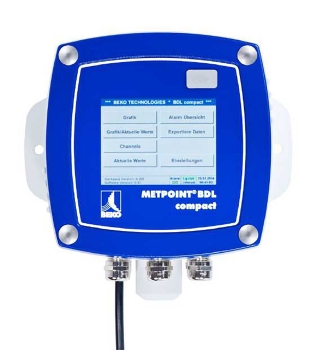
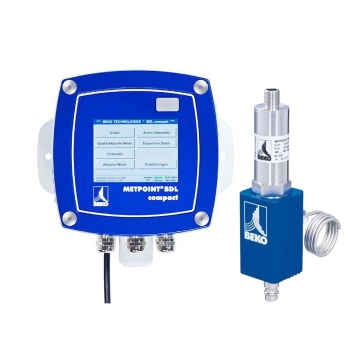


FA 500 - Pressure Dew point sensor with integrated display and alarm relay


Why pressure dew point matters?
Why Monitor the Pressure Dew Point?
Compressed air cools as it travels through piping and equipment. If its temperature falls below the dew point, water vapour can condense. This may cause corrosion, frozen valves, damaged pneumatic components, microbial growth or contamination of sensitive products.
Continuous monitoring provides an early warning when a dryer is overloaded, bypassed or no longer achieving the required outlet condition. Trend data also helps maintenance teams distinguish a short process fluctuation from a persistent deterioration in dryer performance.
- Verify dryer performance at the outlet
- Protect downstream equipment and processes
- Document compressed-air quality over time
- Trigger alarms before moisture reaches critical production areas
- Support energy-efficient dryer operation and maintenance planning

Pressure Dew Point vs Atmospheric Dew Point
Pressure dew point is measured while the gas remains at operating pressure. Atmospheric dew point describes the moisture condition after the gas has expanded to atmospheric pressure. Because expansion changes the relationship between pressure and water-vapour concentration, the two values are not directly interchangeable.
For compressed-air quality control, the measurement pressure must therefore be recorded and the result must clearly state whether it is pressure dew point or atmospheric dew point. A sensor installed directly in the pressurised system reports pressure dew point when used within its specified operating conditions.
SO 8573-1 Water Classes
ISO 8573-1 classifies compressed-air purity for particles, water and oil. The pressure dew point limits for water classes 1 to 6 are shown below. Class 0 is user-defined and must be more stringent than Class 1.
| Water class | Maximum pressure dew point | Typical interpretation |
|---|---|---|
| 1 | ≤ -70 °C | Very dry compressed air for highly sensitive processes |
| 2 | ≤ -40 °C | Common target for adsorption-dried instrument air |
| 3 | ≤ -20 °C | Dry industrial compressed air |
| 4 | ≤ +3 °C | Typical refrigeration-dryer outlet condition |
| 5 | ≤ +7 °C | Moderate moisture control |
| 6 | ≤ +10 °C | Basic moisture limitation |
Source note: ISO 8573-1:2010 purity classes. The final required class must be defined by the process owner and verified under representative operating conditions.
Selecting the correct dew point device
Which Dew Point Meter or Sensor Do You Need?
| Application | Recommended solution | Selection priority |
|---|---|---|
| Refrigeration dryer | FA 500 or suitable FA 515 range | Range around +3 °Ctd; local alarm or control output |
| Adsorption dryer | FA 515 / FA 500 low-range variant | Measurement down to -40 or -70 °Ctd with adequate accuracy |
| Portable audit | DP 510 or BDL Portable with DPM set | Fast setup, measuring chamber, data logging and export |
| Permanent quality record | DPM SD23 with BDL Compact | Trend storage, alarms and integration with plant monitoring |
| Technical gases | Application-verified portable or stationary sensor | Confirm gas compatibility, pressure and required moisture units |

Selection Checklist
- Expected normal dew point and required alarm limit
- Operating pressure and maximum permitted sensor pressure
- Compressed air or gas composition and sensor compatibility
- Stationary monitoring or portable spot measurement
- Required outputs: display, relay, 4–20 mA, Modbus or data logger
- Measuring chamber, connection thread, sample flow and calibration concept
Installation, applications and FAQ
Where Should a Dew Point Sensor Be Installed?
For dryer monitoring, install the sensor downstream of the dryer at a representative point before untreated air can mix with the measured flow. A measuring chamber with controlled sample flow often improves response and makes removal for calibration easier.
- Avoid dead legs and locations where condensate can collect.
- Use diffusion-tight tubing for bypass measurements.
- Confirm that sample pressure and flow remain within the sensor specification.
- Protect the sensor from particles, oil contamination and direct liquid-water exposure as required.
- Allow sufficient stabilisation time after installation or process changes.
- Plan regular verification or calibration according to the manufacturer and quality system.
Typical Applications
- Refrigeration, membrane and adsorption dryer monitoring
- Food, beverage and pharmaceutical production
- Electronics, semiconductor and precision manufacturing
- Instrument air and pneumatic control systems
- Paint shops, packaging and plastics processing
- Residual-moisture measurement in suitable technical gases
Frequently Asked Questions
Pressure dew point is the temperature at which water vapour begins to condense while the compressed air or gas remains at the stated operating pressure.
A correctly selected refrigeration dryer commonly targets approximately +3 °C pressure dew point under its rated operating conditions. The actual value depends on load, inlet conditions and dryer design.
Many industrial adsorption-dryer systems are specified at -40 °C pressure dew point, while more demanding applications may require -70 °C. The process requirement determines the correct target.
Yes, but the result is then an atmospheric or expanded-gas dew point unless it is mathematically converted using known conditions. It must not be reported as the original pressure dew point.
The interval depends on the sensor, contamination risk, criticality and quality requirements. Verify the instrument during commissioning and follow the manufacturer’s calibration guidance.
Only when the manufacturer confirms compatibility with the gas, pressure, moisture range and installation method. The measuring conditions must be documented for meaningful comparison.